About me
I spend my working week inside the AI transition.
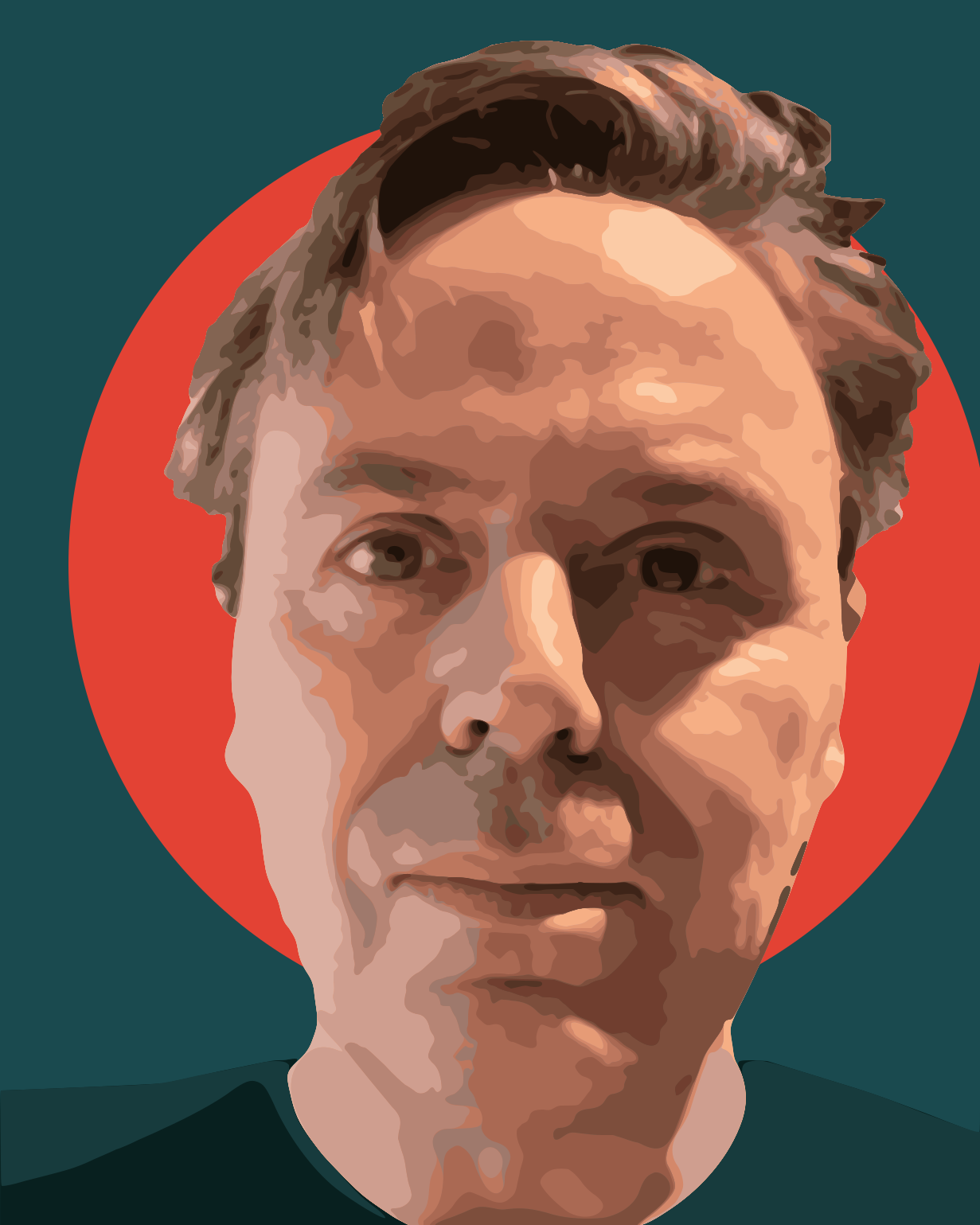
I'm Russell Lack, British and Norwegian, and I've spent my career in American, European and Nordic organisations. I work in English, Norwegian and Swedish. Coaching is something I do part-time, and I keep it fully separate from my day job, where I'm a director at a Nordic IT consultancy running cloud, security, data and AI programmes for clients in shipping, manufacturing, energy and the public sector.
Over 25 years I've worked in media, advertising, technology and design consultancies, as a consultant, a senior manager and a product and service owner. Each time a new wave of digital change came through, I was helping teams and clients onto new platforms, services and operating models. Coaching was always part of that, whether it was one person, a team under pressure, or a whole organisation learning a new way to work.
What I learned each time is that the technology settles long before the people do. The systems go live, the org chart changes, and everyone is left to work out on their own what their expertise is worth now, which decisions are still theirs, and where they fit. AI is the biggest of these waves so far, because it reaches into professional judgement itself. That's the part I help with. I work with one person at a time, on your role, your value and your decisions, so you're the one steering the change rather than only reacting to it.
What I see in my work
- Expertise is being re-priced. The people having the hardest time are rarely the least skilled. More often they're the ones who never had to spell out what made them valuable.
- Decisions are moving around. Work that used to need a senior person's judgement now arrives already analysed, and a lot of senior people are quietly asking what their judgement is for now.
- In my experience the technology is the easy part. What slows a transformation down is identity, authority and trust.
What I bring
A long view
I've been through earlier waves of digital change in television, advertising and consulting. A lot of what feels new about AI is quite familiar on the human side, and it helps to have seen it before.
A current view
I use AI every week, in client work and in tools I build myself. The self-assessments on this site are one of them.
Business and technology together
I'm as comfortable with a P&L as with an architecture diagram, so we can talk about your role, your organisation and the technology in the same conversation.
A method behind it
I'm trained in coaching, change management and enterprise architecture. That gives our sessions some structure, but they're still conversations, not a fixed process.
I focus on the structure and process behind roles and organisations
In my consulting work I think like an architect. I look at the whole system before I touch any part of it, and I ask what keeps it in place. I do the same in coaching, except the system is yours: your role, your relationships, the decisions only you can make, and where your sense of worth comes from.
To be clear, this is coaching, not consulting. I won't redesign your organisation for you, and I won't push you to adopt more AI. We work on how you see your position, what you decide to do about it, and how you bring other people with you. If what you really need is a strategist, I'll tell you.
That way of looking at things helps most when AI shifts the ground under you. Four shifts keep coming up:
Disintermediation
When the steps between your organisation and its customers disappear, the part you used to play can go with them. We look at what that does to your sense of purpose, and where your judgement is still needed.
Losing sight of customers
When customers reach you through platforms and AI, the people you're there for can start to feel distant. We work on staying close to them, and on making decisions when you know less than you used to.
Accelerating competition
When everything speeds up, it's tempting to react to all of it. We work out what's worth responding to, and how you keep your footing and your energy.
Commodification
When what you or your organisation offers gets cheaper to produce, it can feel as if you're worth less too. We separate what has become plentiful from what is still yours: judgement, trust, context and relationships.
Why coaching
Because the hardest part of all this doesn't happen in the systems. It happens in people: how they see their own value, how they make decisions, how much of themselves they bring to work. Transformation programmes rarely leave room for that conversation. Coaching gives it a place, and at senior level it is a confidential conversation between two experienced people, not training.
How I work
- It's confidential. What you tell me stays with me, and I keep my coaching completely separate from my consulting clients.
- We start small: a free twenty-minute conversation, then the Deep Navigation Scan, then the programme if it makes sense for you.
- Every session ends with something concrete you can decide or do.
- You could work through much of this on your own. What I add is an outside view, and someone who holds you to what you decided.
- We meet on video, in English, Norwegian, Swedish or Danish, whichever you think best in.
Certifications
- ICAgile Certified Professional in Enterprise Agile Coaching (ICP-ENT)
- ICAgile Certified Professional in Coaching Agile Transformations (ICP-CAT)
- Prosci Certified Change Practitioner
- Half Double Practitioner (Half Double Institute)
- TOGAF 9.2 Practitioner
Let's start with twenty minutes.
A free, confidential conversation about your self-assessment result or the situation you're in. I won't use it to sell you anything.